Good News!

Contrary to popular belief, the world is not falling apart

It’s easy to think that the world is falling apart. Media driven fear demoralises us – particularly when young – and engenders terrible political decisions

The necessary media spotlight on conflicts like Ukraine and Gaza gives the impression of unprecedented levels of violence – it’s not, it’s unprecedented media coverage of conflict and other horrible incidents like crimes and natural disasters. So much so that media channels seem to promote such scenes to maintain followings.

But wait, take a look at the data:

Last year, 3,5 in 100,000 people died in war, in the 20th Century, there was an average of 30 deaths per 100,000. The world has become far more peaceful.

The data speaks to the constant barrage of contextless catastrophe and doom. Negativity sells, but it informs badly.

The same pattern characterises the climate change reporting. A pervasive and apocalyptic narrative draws  together every negative event, ignoring the data. Fires, for example: the annual global burned area  has been declining for decades with last year being the lowest on record.

Deaths from famine and floods have declined almost 50 fold over the last century.

The world has improved dramatically:

Life expectancy has more than doubled since 1900;

the almost universal illiteracy of 200 years ago has almost disappeared;

in 1820, 80% of the world lived in extreme poverty, now it’s less than 10 percent;.

This incontrovertible progress has been driven by ethical and responsible conduct, trust, well functioning markets, the rule of law, innovation and political stability.

 We need to foster a climate that challenges fear-mongering and promotes optimistic yet critical thinking and constructive discussion regarding the future.

The authors have convened  the Alliance for Responsible Citizenship and their conference commences on 30 October in London. Follow the outcomes.

This is paraphrased from an article by

Jordan Peterson John Anderson The Weekend Australian 28 October 2023

This is the kind of talk you need to listen to. No doubt there will be muted and hypercritical media reporting on this movement – their methods, ethics and calling are under scrutiny, at last!

Say No

Generally speaking people feel uncomfortable objecting to something somebody says or saying “no”.

The desire for social acceptance and fear of causing disappointment or conflict lead us to agree, even when it’s against our best interests. Some of us were brought up with expectations of obedience. Saying “no” to a parent was exceptionally hard; an older sibling would likely give you a thick ear!

So we learned how to express our refusal: often by persistence, pleading, begging and tears. These tactics sometimes worked with Mum. Dad’s response was invariably: “what does your mother say?”

By saying No, I am challenging your power, intimating you are wrong and I am right, disappointing and inconveniencing you, embarrassing you.

The reluctance, discomfort and often fear of saying no is the playground of bullies. Standing up to our teacher, boss or parish priest is almost as difficult. But if successful, a “no” reaps rewards and enhanced respect.

The most challenging “No” of all, is the one you say after having said “Yes” many times before… when there is an expectation of “yes”

Hurt feelings, guilt, shame, embarrassment, sadness, anger and rage are common reactions to a refusal. Here in Australia, the rejection of the Voice referendum has seen all those emotions and more.

Saying no means we need to be able to discriminate – to be to tell the difference between different options and select the right one. We should also learn how to signal our position before being asked, if possible.

For some time I have been uncomfortable with the increasingly commonplace Aboriginal “welcome to country” ritual foisted on audiences; particularly the increased emphasis on this land being “ours”.

I believe it is commonplace before meetings in government departments and even in some churches.

These “welcomes” are not endearing Aboriginal cultural practices; they are in fact political statements which challenge the status quo in Australia.

High Court v Commonwealth 1993: … there is no justification for “the notion that sovereignty adverse to the Crown resides in the Aboriginal people of Australia”

The referendum message does not seem to have got through to the vociferous minority. The special treatment of people on the grounds of their ethnicity has been rejected.

Thirty percent of Australians today were not born here, they have different cultures – they are rightly expected to assimilate and contribute to our society.

The message is: You can say “No” to stuff you didn’t agree to, even the ‘touchy-feely ‘ ethnic and gender stuff.

Question the justification for unnecessary welcomes and cultural, ideological changes in your workplace.

Say ‘No”.

A question of balance

Terror tactics are horrifying and repugnant causing us to recoil. They are used when conventional warfare: i.e. soldiers fighting soldiers, is not pragmatic.

The terror tactics used in Rhodesia during the time of its ‘liberation’ war included the murder of unarmed non-combatants in pitiless, gruesome fashion. This included the execution by shooting of headmen and many tribespeople “pour encourager les autres” accompanied by mutilations, abduction and rape. It included the execution of survivors of a passenger aircraft they had shot down; the murder of missionaries including the bayonetting of a 6 month old baby.

Of course, Europe had its own terrorists like the Red Army Faction  which engaged in a series of bombings, assassinations, kidnappings, bank robberies, and shoot-outs with police.

Governments also use terrorism. In World War II, the Nazis executed villagers in reprisal for attacks on them by resistance partisans.

The Japanese Army is estimated to have executed millions of Chinese and Korean civilians during the same period.

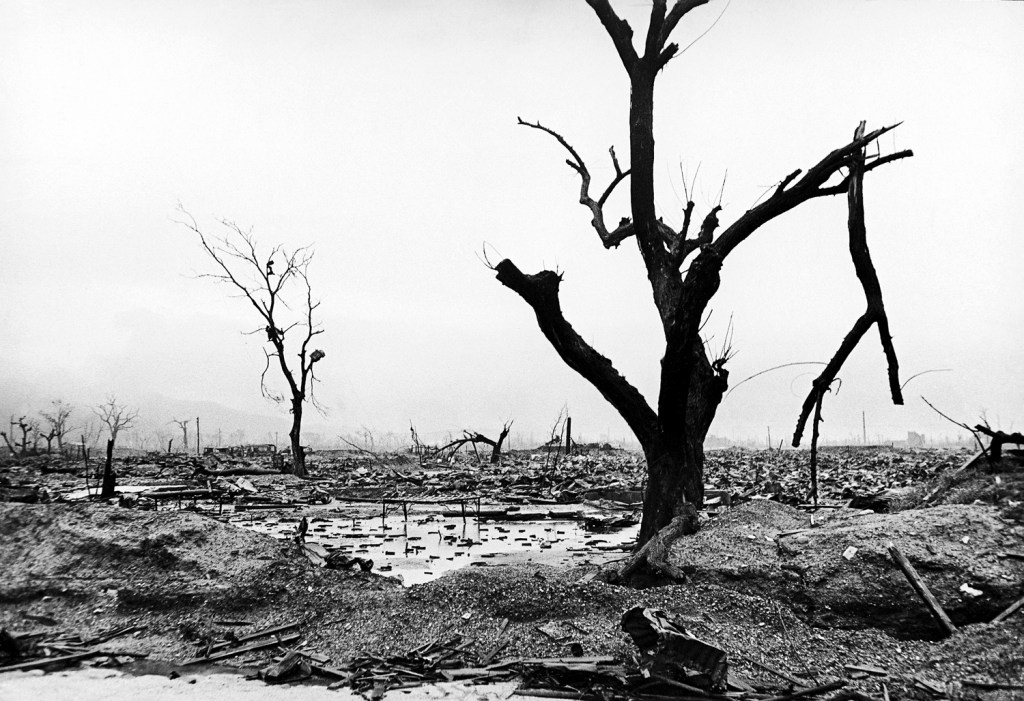
Let us not omit the ultimate terror tactic deployed by the US on Japan in 1945 – the atomic bombs on Hiroshima and Nagasaki which killed over 200, 000 people.

Neighborhood reduced to rubble by atomic bomb blast, Hiroshima, 1945.

Sadly, terror tactics clearly have some “legitimacy” in societies across the world.

This somewhat shatters our moral high ground when considering the Hamas massacres of Israeli residents and indeed the Israeli retaliation and the US support for it.

There is some distaste for the Hamas tactic of hiding amongst the “innocent” population, but it is a brutally clever tactic. Why should non-combatants not share the fight in a liberation struggle?

Of course, this type of thinking means that the only tactic to stop this type of warfare is eradication and suppression – obliteration will buy a few years until new ideologists fire up the youth of a new generation. Unavoidably, non-combatants will also be obliterated.

We can express our horror and repugnance, but we can not condemn the morality if we too are guilty.

It goes without saying that terrorists should be stopped before they attack.

But, how is this possible?

One answer which many will not like, is universal surveillance: the continuous monitoring of every meeting, conversation and movement of ….. everybody.

Don’t be alarmed, surveillance of communications and movement is commonplace in the military and security industries, including the police. Many private houses and vehicles already have security camera systems which track you whenever you pass by; you are watched in supermarkets, bars and train stations. Internet traffic is monitored and filtered by service providers.

Why do we still need a warrant to monitor criminal activities? AI bots can monitor and notify suspicious behaviour for investigation, in real time as it happens.

It will be far more effective in stopping terrorists and criminals than analysis of historical data, so what is the downside?

After all: “freedom’s just another word for nothing left to lose”!

I wrote this poem for a poetry class some years ago.

Screen

camera-security

Everyone everywhere should be screened

Let the camera capture

your face, your life, your ups and

downs.

And hers and his and theirs.

All must be screened – t’will

make us feel safer and happier, until

we think about

Who screens

the Screeners.

Look at the screen

be obscene and herd:

you’re on tv!

This is our new morality

I was on tv

did you see me?